Neomind Updates

5 min read
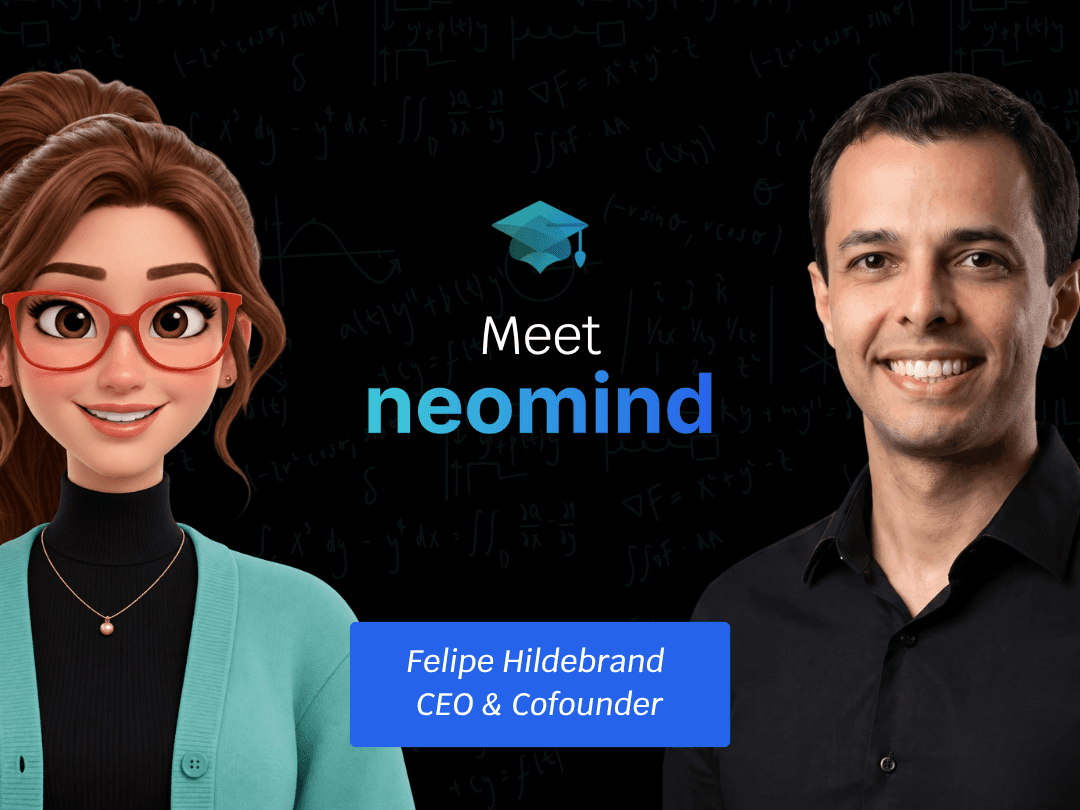
Breaking Education’s Generational Constraint: Why We Built Neomind by Felipe Hildebrand, CEO & Co-founder.

Today, Neomind is born. We are launching a company built on one conviction: that the quality of teaching a child receives should not depend on what their parents can afford. Today is an important milestone for the work we have been incubating for the last year and a half. So let me start where it actually started.

Author: Felipe Hildebrand

Breaking Education’s Generational Constraint: Why We Built Neomind by Felipe Hildebrand, CEO & Co-founder.

Today, Neomind is born. We are launching a company built on one conviction: that the quality of teaching a child receives should not depend on what their parents can afford. Today is an important milestone for the work we have been incubating for the last year and a half. So let me start where it actually started.

Author: Felipe Hildebrand

Meet Neomind - AI math tutor

The conception

My daughter had started at a new school, studying in English, which is not her first language. She was learning to think in a second language, while having to keep up with the challenges of building her numeracy and literacy skills. The school was excellent. The teachers cared. Still, I could not tell where she stood, or how best to support her. I was not watching a school fail. I was watching a model reach its limit.

One teacher, twenty students, one pace. That model was a magnificent achievement in its time. It took education from a privilege of the few to a right of the many. However, that achievement was made possible through the industrialization of education. And it cannot cater to the individual needs of each child. It was never built to.

In Spring 2025, I sat down with Amos and Rodolfo, two long-time partners and mentors. The conversation was supposed to be about AI, but - triggered by this personal story of mine - it became about Education.

Almost everything being built with AI was aimed at doing existing work faster, cheaper or more efficiently. Very little was aimed at changing what was possible. And of everything AI might change, education looked the most impactful and somewhat neglected… despite the myriad of EdTechs and their big promises.

The conception

My daughter had started at a new school, studying in English, which is not her first language. She was learning to think in a second language, while having to keep up with the challenges of building her numeracy and literacy skills. The school was excellent. The teachers cared. Still, I could not tell where she stood, or how best to support her. I was not watching a school fail. I was watching a model reach its limit.

One teacher, twenty students, one pace. That model was a magnificent achievement in its time. It took education from a privilege of the few to a right of the many. However, that achievement was made possible through the industrialization of education. And it cannot cater to the individual needs of each child. It was never built to.

In Spring 2025, I sat down with Amos and Rodolfo, two long-time partners and mentors. The conversation was supposed to be about AI, but - triggered by this personal story of mine - it became about Education.

Almost everything being built with AI was aimed at doing existing work faster, cheaper or more efficiently. Very little was aimed at changing what was possible. And of everything AI might change, education looked the most impactful and somewhat neglected… despite the myriad of EdTechs and their big promises.

Neomind AI math tutor

The scale of it

Two months after that first conversation I left my sixteen-year job in consulting to build what we believe education can become. Here is what pushed me over the edge.

An astonishing 45% of 12th graders in the US score below basic in math. Not below proficient, below basic! And worse, the gap between top and bottom performers has been widening, not closing. The top performers are improving scores while the lowest quartile is continuing to fall.

And a child who loses math at twelve does not experience any of this as a door of opportunity closing. They experience it as a subject they are bad at. The door closes years later, quietly.

We have known the answer for forty years

In 1984, Benjamin Bloom published one of the most cited findings in education research. Comparing students taught in conventional classrooms against students given one-to-one tutoring with mastery learning, he found that the median tutored student outperformed 98% of the students in the conventional group.

Ninety-eight percent. Same curriculum. The only variable was that somebody was paying attention to one child at a time. But Bloom also admitted: one-to-one tutoring was too costly for most societies to bear on a large scale.

So the constraint was never knowledge. It was the scarcity of good teachers.

A child who receives an answer has finished a task. A child who has been taught has changed. Those are very different things, and the latter is slower, harder, and the only one that really matters.

Felipe Hildebrand, CEO & Co-founder

The constraint just broke

That is what changed, and it is the entire reason Neomind is born.

For the first time, the cost of delivering something close to genuine one-to-one teaching is no longer prohibitive. Not free, but low enough that the question stops being who can afford it.

I want to be careful here, because this is where I think most of the industry is going wrong.Most of what is being built with AI in Education optimizes for the answer. Ask a question, receive a solution, move on. It is fast and it feels productive. But often it is close to the opposite of teaching.

A child who receives an answer has finished a task. A child who has been taught has changed. Those are very different things, and the latter is slower, harder, and the only one that really matters.

Introducing Neomind: what we built instead

Most tools answer the question a student asks. Ours is built to work out why the question was hard. It means the system has to understand before it teaches. Before a lesson happens, it has to know where the learner actually is: what they have mastered, where the gap first opened, which misconception is quietly breaking everything downstream.

At the center of Neomind sits:

· The Learning Genome, a map of how each child reasons, learns, and engages. This allows us to craft every single lesson individually to each student. And the map sharpens with every interaction;

· The Instructional Mentor, a teacher designed from the first day to feel human: it reads engagement, builds rapport, and responds with the warmth and intuition of a great educator.

Emotional intelligence and true personalization are not features added late. They are the tenets the whole system was built around.

We spent the last year and a half building Neomind. Today, we are opening the doors and beginning the next chapter: one that will be filled with learning, iteration, and a great deal of humility.

We started Neomind because we believe a parent’s income should not determine how far their children can go. We believe we have a responsibility to put AI to work for that purpose.

And so, today, Neomind begins.

Share Insight:

Neomind is the world's first Personal Learning Intelligence. A new category of education built to understand the learner, not just deliver content.

Copyright © 2026 Neomind Learning,Inc.
All rights reserved.

Let’s Connect

Icon

Icon

Icon

Icon

Icon

Icon

Neomind is the world's first Personal Learning Intelligence. A new category of education built to understand the learner, not just deliver content.

Let’s Connect

Icon

Icon

Icon

Icon

Icon

Icon

Copyright © 2026 Neomind, Inc.
All rights reserved.

Neomind is the world's first Personal Learning Intelligence. A new category of education built to understand the learner, not just deliver content.

Copyright © 2026 Neomind Learning,Inc.
All rights reserved.

Let’s Connect

Icon

Icon

Icon

Icon

Icon

Icon